Name of case study
The Funafala Garden: Tuvalu Food Cubes
Location
- Funafala
- Tuvalu
Year
2021
Scale
building/single site
Area / size
1.2 acres/0.5 hectares
NbS employed
Container gardens
Type of NbS
Hybrid living/engineered interventions
Initiator
The Pacific Community (SPC) and Live & Learn Environmental Education Tuvalu
Funder
The Pacific Community (SPC) and Live & Learn Environmental Education Tuvalu
Budget
Specifics unknown. Foodcubes average at $NZ350 each, and Tuvalu has 80-100 of them, which would be $28,000 – $35,000.
Design group
Biofilta designed the Foodcube system.


- Changes in rainfall
- Desertification
- Increased pests/weeds
- Increased temperatures
- Loss of food production
- reduced soil quality
- Sea level rise
- Soil erosion and landslides
- Urban heat island effect
- Wind / storm damage
Typical agricultural methods in Tuvalu are threatened by climate change. Changes in rainfall, increased temperatures and sea level rise have led to soil erosion, storm damage, reduced soil quality and a loss of reliable food production. Tuvalu’s highest elevation above sea level is only 5 metres.
The pandemic showed that a reliance on external food sources and supply chains is not sustainable. The Funafala Garden is a way to create a reliable food source that can be managed by the local community, teaching them new skills and keeping everything local.
Additionally, water is increasingly becoming a precious resource in many places in Te
Moananui Oceania, and Tuvalu has no renewable water resources. The ability to create this system so that less water is needed to maintain it is essential.
- Food security
- Empowerment / equality
The Funafala Garden is locally managed, and provides a space for the community to work together, learn together, and take responsibility for their food source. This is both empowering and a return to the traditional reciprocal relationship with the land. By teaching communities how to grow their own food in a sustainable way, projects like this create long-term nutrition and health benefits for the people of Tuvalu.
- Food production (for humans)
The Funafala Garden secures a food source for the local community. Both the pandemic and climate change have made clear that typical agricultural methods and external food supply chains cannot be relied on.
Summary of case study
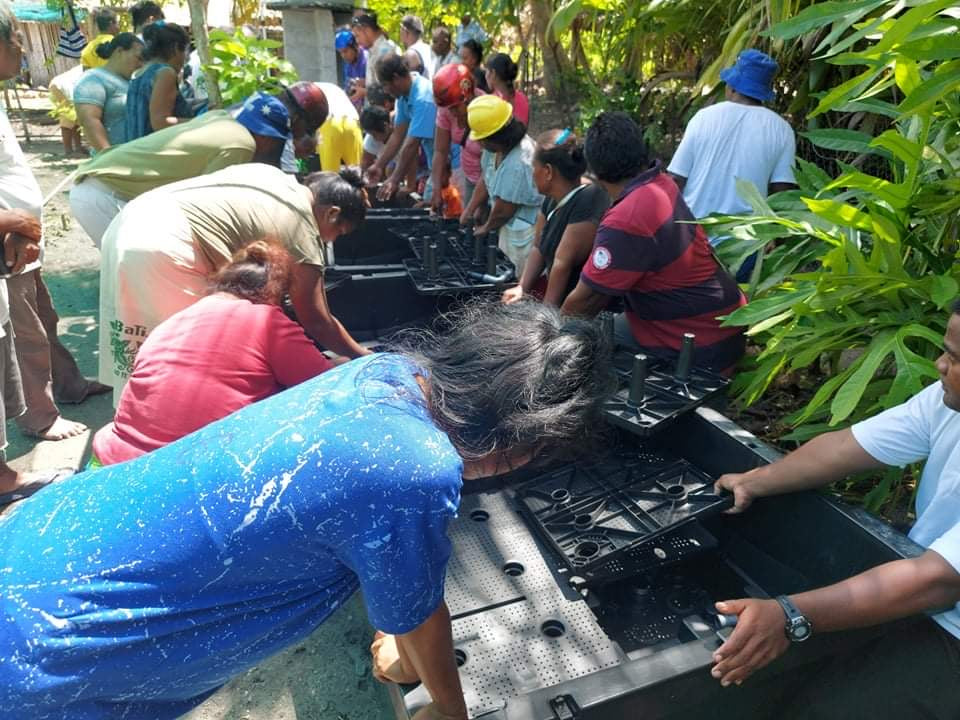
The Funafala Garden in Tuvalu is a large garden made up of modular containers. 80-100 Foodcubes sit on 1.2 acres, growing fruit and vegetables for more than 16 local households. The cubes are one metre square, 30 centimetres deep and manufactured from 80% recycled, food-grade plastic (Wilson, 2021).
In 2021, Tuvalu adopted the use of the Foodcube system, to increase the reliability of crops and food security. The Foodcube system was designed by Australian company Biofilta, who design urban food growing systems. The Foodcube is a modular, water-efficient, low-tech, soil-based box that can be installed quickly, and moved as needed (Biofilta, 2024).
The cubes in the Funafala Garden grow local foods like puluka, taro, figs, cassava, dwarf bananas, and dwarf pawpaw trees, and can produce up to 150 kilograms of vegetables and greens in a year (Wilson, 2021).
Tuvalu is a small atoll island of around 11,300 people. Food gardens in Tuvalu are often affected by extreme weather and sea level rise, so communities often rely on imported food (Wilson, 2021). During the pandemic, as food supply chains were affected, it became clear in Tuvalu that a local, reliable source of fresh produce would be invaluable. Like much of the Pacific, Tuvalu’s people endure food insecurity and low levels of nutrition. 80% of men and 83.8% of women were classified as overweight in Tuvalu in 2016, while diabetes afflicts 23.1% of adults, according to the World Health Organization (Wilson, 2021).
The Funafala Garden is being guided by Pacific Community (SPC) in an attempt to increase food security in Tuvalu.
The Foodcubes are raised off the ground, to protect them from water inundation, and their modular construction means they can be watered together. They use less water than traditional agriculture methods, which is especially important in Tuvalu, where water scarcity is a pressing issue. The Garden uses compost and its modular system gives local food growers control over their harvests.

References
- Wilson, C. (2021). Atoll Nation of Tuvalu Adopts ‘Cubes’ to Step Up Nutritious Food Production. Pacific Community. Available online: https://www.spc.int/updates/blog/partners/2021/10/atoll-nation-of-tuvalu-adopts-cubes-to-step-up-nutritious-food. Date accessed: 12 May, 2024.
Further resources: