Name of case study
Hua Orchards Windbreaks
Location
Oahu, Hawai’i
Year
2019
Scale
urban/landscape
Area / size
n/a
NbS employed
Wind-caused erosion prevention
Type of NbS
Created or constructed living ecosystems, Ecosystem protection
Initiator
Private company
Funder
Hua Orchards
Budget
n/a
Design group
Remy and Daniel Carroll (Owners)


- Biomass cover loss
- Increased pests or spread of weeds
- Loss of food production
- Loss of other ecosystem services
- Reduced soil quality
- Soil erosion
- Wind damage
- Climate change adaptation
- Food security and quality
- Disturbance prevention (erosion, storm damage, flooding etc.)
- Habitat provision
Summary of case study
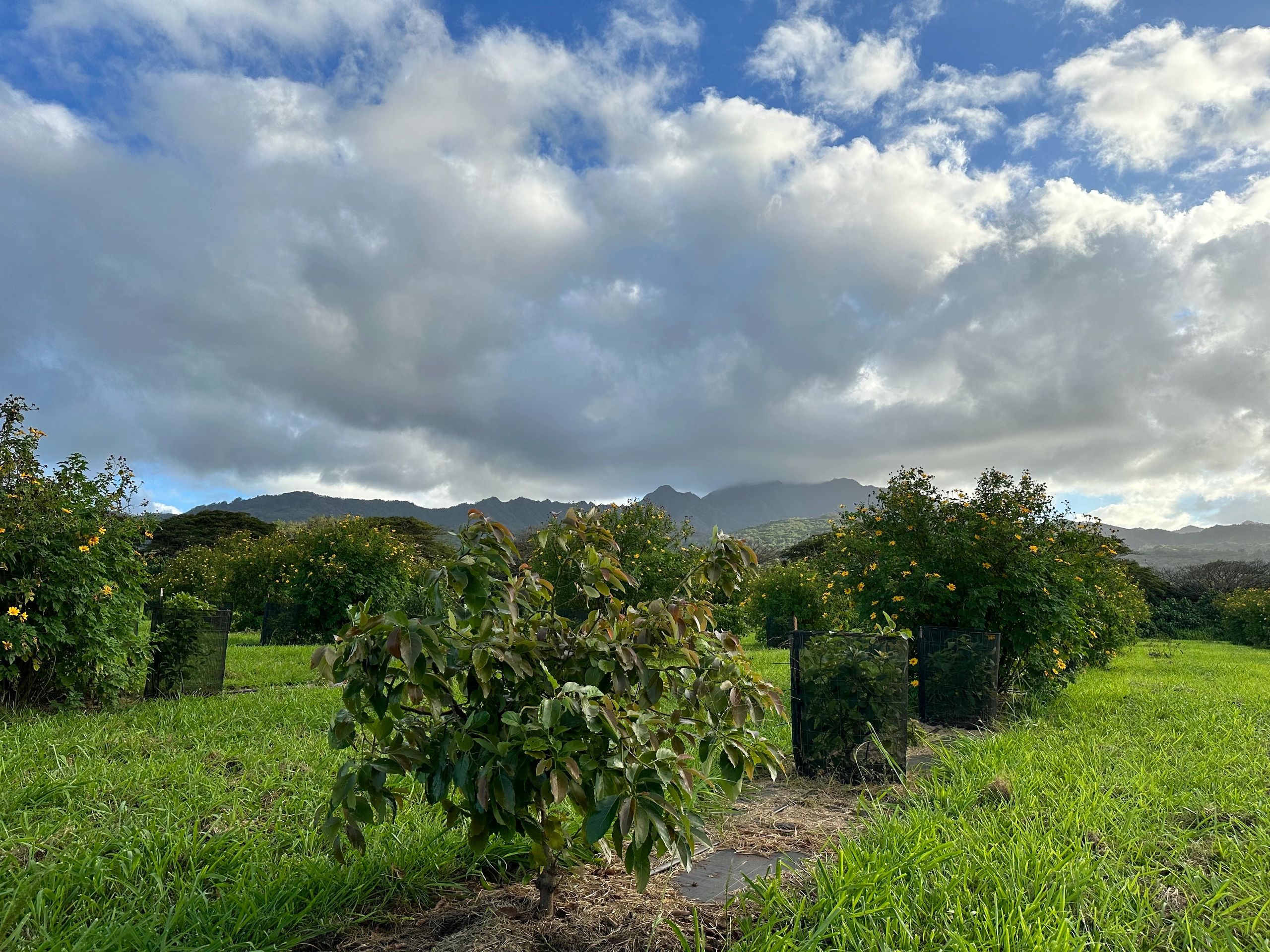
Hua Orchards is located in Oahu, Waialua, Hawai’i, growing primarily numerous varieties of avocado, Tahitian lime, other tropical fruit and flowers using organic and regenerative farming techniques (Windbreaks, Strip-Tilling and More with Hua Orchards., n.d.).
The land where the orchard is located receives strong predominant northeasterly winds which pose challenges to soil health. In order to prevent soil erosion the farmers utlilised cover crops of perennial peanut and white clover (Windbreaks, Strip-Tilling and More with Hua Orchards., n.d.). Despite this the effect of the wind makes it difficult to maintain adequate soil moisture and evapotranspiration rates in the dry months, and without irrigation it is difficult to maintain enough vegetation to keep the soil covered. Additional environmental pressures included pollution from a nearby roadway and contamination from a neighboring livestock farm (Windbreak Installations: A Co-Management Practice, 2021).
To mitigate these effects, the orchard is testing perimeter and in-field windbreaks to reduce wind speeds, maintain soil moisture levels, reduce evapotranspiration rates and manage soil temperature levels (Windbreaks, Strip-Tilling and More with Hua Orchards., n.d.). In-field windbreaks are primarily made up of the rapidly growing Mexican Sunflower (Tithonia diversifolia) which has the added benefit of being a host for pollinators and other beneficial insects. Perimeter windbreaks are made up of several varieties of clumping (non invasive) bamboo. Both species were selected because of their rapid growth, growth habits higher than their main crops, and local availability. Alongside these wind breaks the farmers are incorporating native or other useful tree species in windbreaks and tree rows such as neem, , milo and koa that are naturally suitable for their local conditions (Windbreak Installations: A Co-Management Practice, 2021).
When establishing new plantings, the orchard uses a method called strip-tilling, which cultivates only the tree row areas for planting, leaving the existing field vegetation in place to maintain soil stability and soil moisture (Windbreaks, Strip-Tilling and More with Hua Orchards., n.d.).
The use of combined techniques at Hua Orchards will reduce costs for the project, primarily relating to irrigation and also mitigate the effects of strong winds and the associated issues of stripping soil moisture, soil erosion and wind-carried pollutants, increasing crop security and quality. There are biodiversity outcomes as well, with windbreaks and inter-planting providing habitat for beneficial insect species, restoring plant species diversity, providing useful materials, and other ecosystem services like micro-climate creation and reduction of soil temperature.
References
- Windbreak installations: A co-management practice. (2021, April 20). Oahu Resource Conservation & Development Council. https://www.youtube.com/watch?v=r4gmAlzMsXsWindbreaks, strip-tilling and more with Hua Orchards. (n.d.). Oahu Resource Conservation & Development Council. https://learn.oahurcd.org/soil-health-practices-menu/windbreaks-strip-tilling-and-more
Further resources: