Name of case study
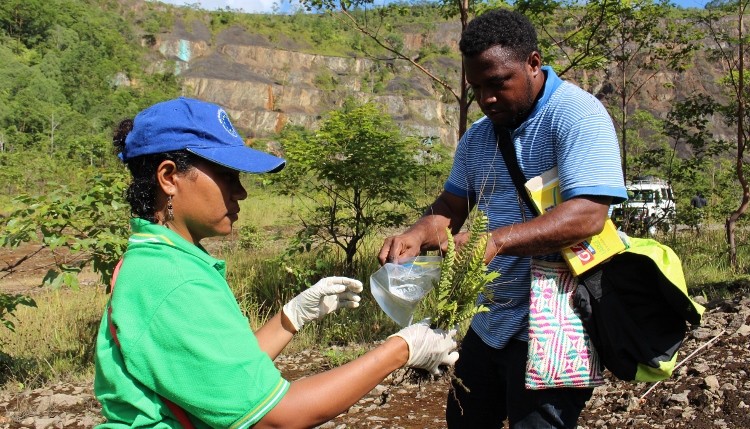
Namie Mine Phytoremediation
Location
Morobe Province, Papua New Guinea
Year
2014-2016
Scale
Landscape scale
Area / size
Unknown
NbS employed
Bioremediation / phytoremediation of soil
Type of NbS
Ecosystem restoration
Initiator
PNG University of Technology, Pacific Agriculture Alliance
Funder
The Christensen Fund and others
Budget
Unknown
Design group
Not applicable

- Increased pests or spread of weeds
- Loss of food production
- Reduced soil quality
- Reduced water quality
- Soil erosion / landslide
- Food security and quality
- Empowerment / equality
- Water security and quality
- Food production (for humans)
- Purification
- Soil building

Summary of case study
Phytoremediation is an approach to land rehabilitation that utilises plants to absorb and stabilise pollutants (Rungwa et al., 2013a). Phytoremediation represents a promising avenue for restoring environments impacted by mining activities in Papua New Guinea. By harnessing the natural abilities of plants, this nature-based technology may offer a sustainable and economically viable approach to remediate contaminated sites and promote ecological resilience (Rungwa et al., 2013b). Ongoing research and implementation efforts aim to leverage phytoremediation as a key tool in addressing environmental degradation and promoting long-term sustainability in PNG (Rungwa et al., 2013b).
Mining operations in Papua New Guinea (PNG), typically gold, have yielded earnings but have also led to significant environmental degradation, particularly in areas surrounding mining sites (Rungwa et al., 2013a). The Morobe goldfield in Morobe Province has a history of mining activity, dating back to the 1920s. However, the environmental impact of these activities has been substantial, affecting both land and water systems (Rungwa et al., 2013a). Heavy metals, such as cadmium, copper, iron, mercury, lead, and zinc, have contaminated soil, vegetation, waterways, and marine life, posing significant ecological and health risks (Rungwa et al., 2013a). Issues such as dieback at Ok Tedi mine, cyanide spillage at Misima gold mine, and direct waste dumping at Lihir gold mine have contributed to instability in local ecosystems (Rungwa et al., 2013a). Some revegetation work has been done to remediate mines with good results (Rungwa et al., 2013b). Phytoremediation can be used in conjunction to more effectively address soil toxicity caused by heavy metal contamination from mining in addition to revegeation.
By harnessing the phytoextractive abilities of specific plant species, such as hyperaccumulators of arsenic, cadmium, mercury, and lead, contaminated soils can be remediated over time (Rungwa et al., 2013b). Phytoremediation has been successfully investigated in past rehabilitation efforts, such as the Namie Mine in Morobe Province (Rungwa et al., 2013b). Phragmites karka, a native plant, for example, has demonstrated effectiveness in absorbing heavy metals from mine soil environments in Namie (Rungwa et al., 2013a).
Organisations like the Pacific Agriculture Alliance (PAA) are actively promoting research and development in agriculture and biodiversity preservation in the Pacific region. Research initiatives at institutions like the PNG University of Technology are further advancing the understanding and application of phytoremediation in PNG’s unique environmental context (Rungwa et al., 2013b).
The effectiveness of phytoremediation for mining damage in PNG relies on identifying suitable plant species with robust root systems and efficient metal translocation mechanisms (Rungwa et al., 2013b). Technologies like inductively coupled plasma spectroscopy (ICP) enable precise quantification of heavy metal concentrations in plant tissues, aiding in monitoring and assessment efforts (Rungwa et al., 2013b).
While mining activities continue to pose social and environmental challenges in PNG, regulations like the Environmental Planning Act aim to mitigate these impacts and guide rehabilitation.

References
- Rungwa, S., Arpa, G., Sakulas, H. W., Harakuwe, A. H., & Timi, D. (2013a). Assessment of Phragmite karka (pitpit) as Possible Phytoremediation Plant Species for Heavy Metal Removal from Mining Environment in PNG. A Case Study on Closed Namie Mine Wau, Morobe Province. In The Proceedings (Vol. 9).
- Rungwa, S., Arpa, G., Sakulas, H., Harakuwe, A., & Timi, D. (2013b). Phytoremediation–an eco-friendly and sustainable method of heavy metal removal from closed mine environments in Papua New Guinea. Procedia Earth and Planetary Science, 6, 269-277.
Further resources: