Name of case study:
Auckland Central Library Living Roof
Location
Tāmaki Makaurau Auckland, Aotearoa New Zealand
Year
2021, completion in April 2022 with ongoing maintenance.
Scale
Building/Site
Area / size
unknown
NbS employed
Extensive Green Roof
Type of NbS
Hybrid Living
Initiator
Auckland City Council
Funder
Auckland City Council
Budget
$NZ730,000
Design group
Ngāti Whātua Ōrākei led the design process in partnership with Natural Habitats
- Biomass cover loss
- Changes in rainfall
- Increased temperatures
- Indirect health, social, cultural climate change impacts
- Reduced air quality
- Reduced water quality
- Storm surge
- Urban heat island effect
- Biodiversity health and conservation
- Climate change adaptation
- Energy security
- Human physical health and wellbeing
- Pressures of urbanisation (waste management, hygiene, etc.)
- Water security and quality
Aesthetic value / artistic inspiration
- Climate regulation
- Creation of a sense of place
- Cultural diversity and history
- Education and knowledge
- Habitat provision
- Purification (of water, soil, air)
- Relaxation and psychological wellbeing
Summary of case study
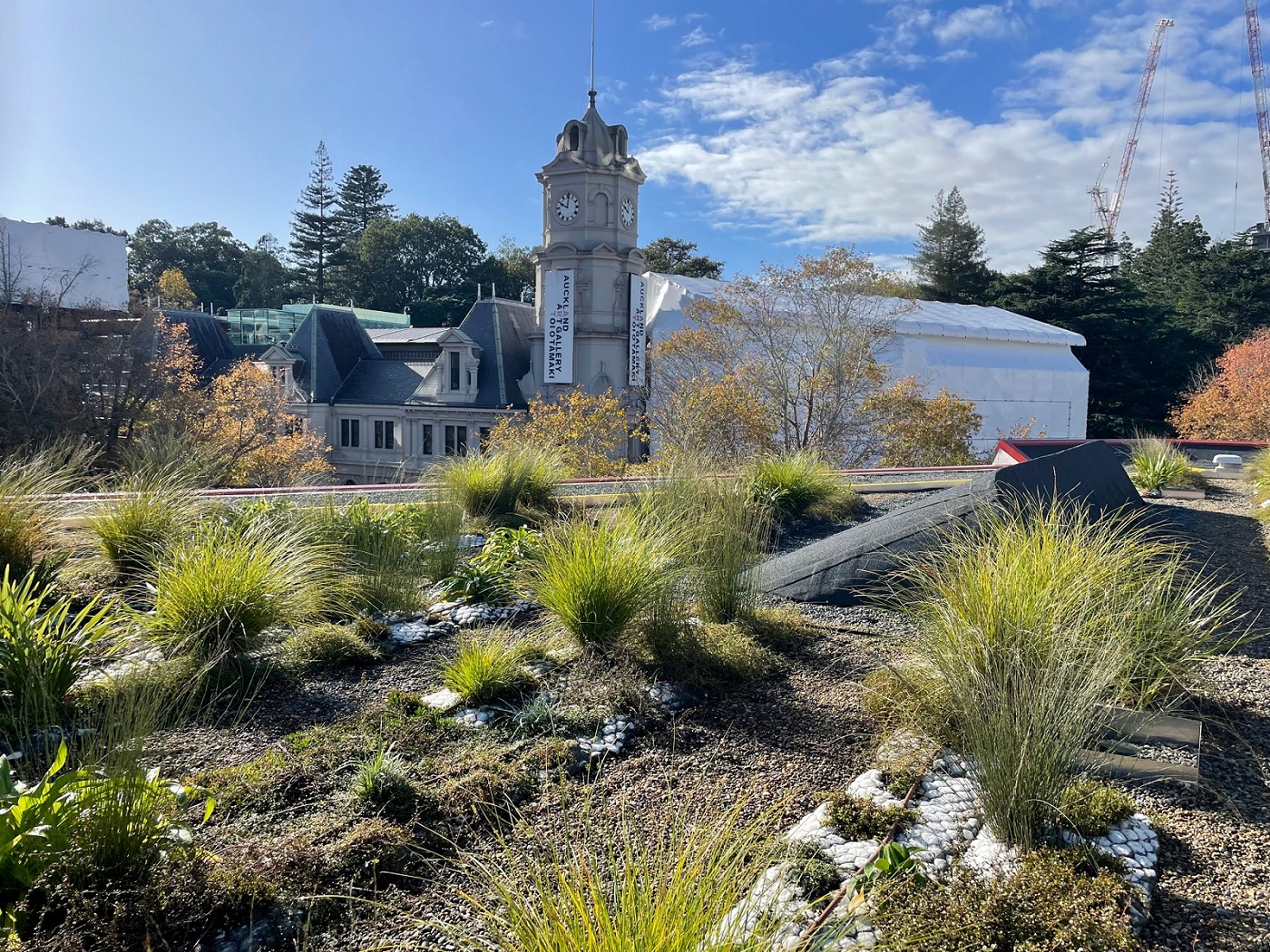
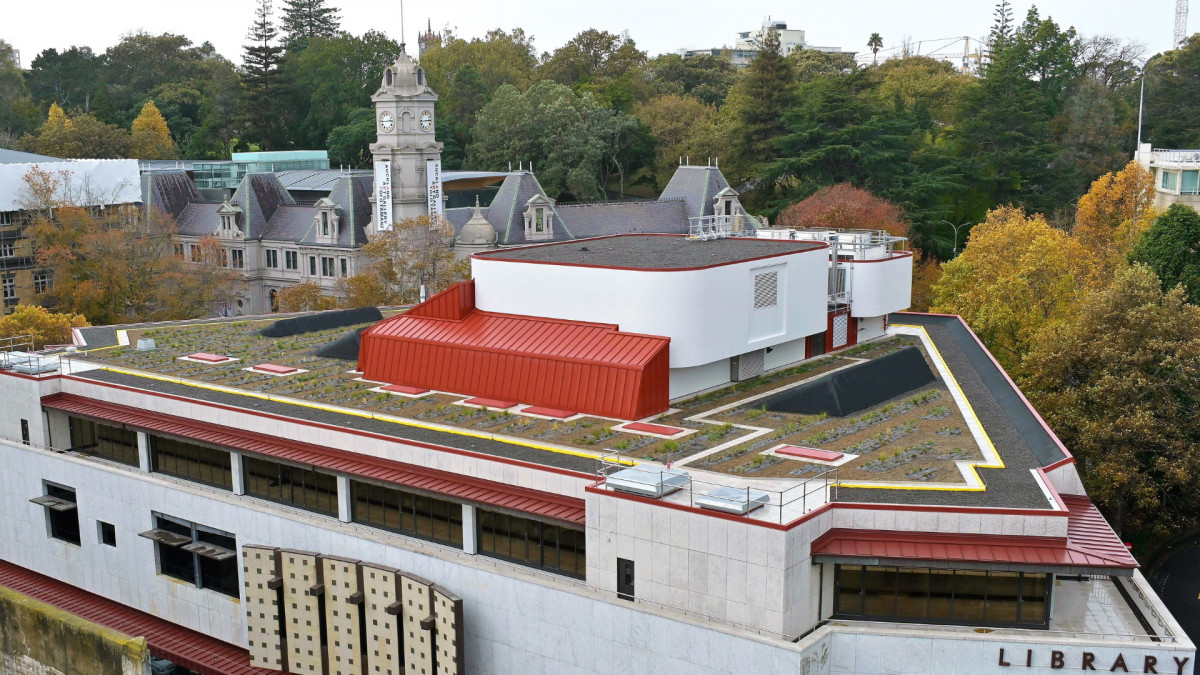
In response to the roof repair work needed on the 50-year-old Auckland Central Library building, Auckland Council took this as an opportunity to ‘retrofit’ an extensive green roof as an alternative top layer to usual stone ballast. The project is the largest Auckland Council-owned building employing a nature-based design solution of this type, and is a notable example of an effort to steer Tāmaki Makaurau Auckland towards initiating more green urban infrastructure as part of the city’s Climate Plan (Our Auckland 2022).
Local iwi Ngāti Whātua Ōrākei led the design process in partnership with landscaping company Natural Habitats. Over 2000 native plants were propagated in Ngāti Whātua Ōrākei’s nursery, which were specifically selected to withstand the exposed rooftop conditions across the extremes of seasons. The plants have been planted in ‘eco-pillows’, a bespoke system created by Natural Habitats. 560 of these eco-pillows measuring 1000 x 500 x 120 mm have been installed on the library roof. Made from recycled polystyrene from Auckland’s waste stream, these planters are suitably lightweight to lessen the load on the library roofing structure. According to Natural Habitats, by using a special mix of growing media, the plants can thrive at height without the extra soil and associated structural reinforcing that other green roofs require (Natural Habitats, n.d.). Furthermore, the design of these eco-pillows prevents soil particles from filtering into drainage and stormwater systems. Allco Waterproofing Solutions Ltd. provided and installed the waterproofing membrane and system to support the planting of the green roof (Allco, n.d.).
This project demonstrates the integral role of mana whenua (local indigenous people) in the design process of public and civic spaces within Aotearoa New Zealand. This is not only to enhance Māori presence, visibility, and participation in the physical realm (Paul, 2017) but also to integrate the rich traditional ecological knowledge that Māori have practised or passed on for generations as kaitiaki (guardians) of the whenua (land) effectively into urban design and planning to help adapt to the twin and intersecting forces of climate change and urbanisation. (Kiddle et al., 2021). The roof design is inspired by whāriki, a plaiting style of weaving representing the laying of foundations for all that it bears. A poutama pattern is integrated into the design which Ngāti Whātua Ōrākei artist Hinengarangi Makoare explains symbolically represents education, progress, and ascension. The inclusion of mātauranga Māori (Māori knowledge) is also present in the native plant selection. Plants that would have originally grown along the Waihoritiu stream which runs beneath the city center, were chosen to celebrate the pre-colonial socio-ecological history of Tāmaki Makaurau (Auckland).
The Auckland Central Library Living Roof provides a range of climate change benefits and co-benefits for human and non-human wellbeing that include stormwater management by reducing rainfall runoff, counteracting the urban heat island effect in the city center, increasing biodiversity and habitat opportunities for insects and birds, providing a carbon sink, and supporting improved air quality outcomes (Our Auckland 2022).
While the value benefits are yet to be quantified and recorded for the Auckland Central Library Living roof, there is research to support that green roofs can reduce the energy consumption of a building, providing insulation and maintaining indoor temperatures. A green roof can also protect the roof membrane from the elements, extending the lifespan of the roof itself (Lewis, et al., 2015).


References
- Allco (n.d). Green Roof benefits far exceed sustainability. https://www.allco.co.nz/green-roof-benefits-far-exceed-sustainability/
- Kiddle G.L., Pedersen Zari M., Blaschke P., Chanse V., Kiddle R. (2021). An Oceania Urban Design Agenda Linking Ecosystem Services, Nature-Based Solutions, Traditional Ecological Knowledge and Wellbeing. Sustainability. 2021; 13(22):12660. https://doi.org/10.3390/su132212660
- Lewis, M., James, J., Shaver, E., Blackbourn, S., Leahy, A., Seyb, R., Simcock, R., Wihongi, P., Sides, E., & Coste, C. (2015). Water sensitive design for stormwater. Auckland Council Guideline Document GD2015/004. Prepared by Boffa Miskell for Auckland Council.
- Natural Habitats Landscapes (n.d). Auckland Library Green Roof.
- https://www.naturalhabitats.co.nz/our-projects/auckland-city-library-green-roof/
- Our Auckland (2022, May 23). Central Library Living Roof sets sustainable example.
- https://ourauckland.aucklandcouncil.govt.nz/news/2022/05/central-library-living-roof-sets-sustainable-example/
- Paul, J. Exploring Te Aranga Design Principles in Tāmaki, 2016.
Further resources