Name of case study
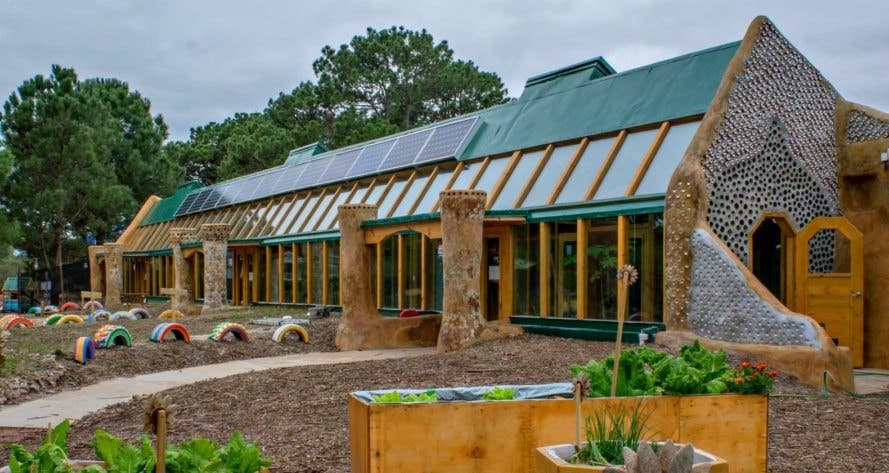
Earthship Te Timatanga (atrium)
Location
- Hikuai
- Coromandel
- Aotearoa New Zealand
Location
2015
Scale
Building / single site
Area / size
240m2 building on 1 hectare
NbS employed
Interior greenhouses
Type of NbS
Hybrid living/engineered interventions
Initiator
Sarah Rowe and Gus Anning
Funder
Sarah Rowe and Gus Anning
Budget
NZ$1,200-$1,400 per m2
Design group
Building Designer: Harriet Pilkington, Young and Richards. Consulting architect: Graeme North, Graeme North Architects. Earthship building consultants: Ben Garratt, Rosa Henderson, Sculpted Earth.


- Changes in phenology (changes in plants and animals)
- Loss of food production
- Reduced soil quality
- Wind / storm damage
- soil erosion and landslides
- increased temperatures
- increased pests / weeds
- Flooding
- Drought
- Desertification
- salt water intrusion into aquifers
- changes in rainfall
Greenhouses and Earthships provide a climate controlled, local alternative for growing produce, for generating renewable energy and supporting local ecologies.
- Disaster risk reduction and resilience
- Empowerment / equality
- Food security & quality
- Human physical health and wellbeing
The Earthship model addresses six basic human needs: food, energy, clean water, shelter, waste management and sewage treatment, all in one building. As we adapt to climate change, deal with food insecurity and quality, and seek to improve physical health and wellbeing, a home built with the Earthship model can do all of this on one site.
This home is generating more energy than it uses, dealing with all its water needs on site, heating and cooling itself and creating a genuinely comfortable environment to live in. This could be the future of sustainable design, where there is self-reliance, self-sufficiency and renewable energy.
- Food production
- Nutrient cycling
- Biological control (regulation of pests and disease)
- Disturbance prevention


Summary of case study
The Atrium of Earthship Te Timatanga is a home in Hikuai, on the Coromandel Peninsula in Aotearoa New Zealand. It is an example of the Earthship design methodology.
The Earthship concept was developed by Michael Reynolds, an American architect. It is an autonomous home, constructed sustainably from natural and repurposed materials that can be built by the owner using common tools (Freney, 2012). The home is designed to be passively heated, cooled and ventilated, with self-contained sewage treatment and water recycling, as well as internal food production.
Sarah Rowe and Gus Anning spent three years researching how to build a sustainable home on their plot of land at the base of the Coromandel Range. Anning is an architectural designer with a keen interest in Reynold’s Earthship strategy. He sketched the initial design, which was then refined for consent.
The Earthship principles:
The six main principles of an Earthship home (Earthship Biotecture, 2024) are:
- Use of natural and recycled materials: Affordable, easily accessible building materials.
- Passive heating and cooling: Thermal Mass, insulation and passive Solar heating/cooling
- Solar and wind energy production
- Food production: A greenhouse attached to the building for year-round crop production
- Water harvesting
- Contained sewage treatment
Each of these principles has its own technical requirements. More information about Earthship can be found on the Earthship Biotecture website.
To heat and cool the home, windows are angled to 70° along the atrium that runs along the front of the home. Natural ventilation and thermal mass heat and cool, and manage the temperature flowing through the atrium into the bedrooms and bathrooms behind.
The walls are made of around 1100 repurposed tyres, stacked and filled with clay. Over a summer in 2015, volunteers built the walls. The house is dug into the bank at its southern side and protected with waterproof membrane. The subfloor is lined with local mussel shells, waterproof membrane and concrete. Internal walls are second-hand mudbricks. Foraged bottles make featured walls.
The atrium houses a garden, a key part of the heating and water system. Rainwater is used for cooking and drinking, and the greywater from laundry and showers is filtered into the planter, which starts shallow at the front door end and gets deeper as it runs through the house (Houzz, 2017). Rocks and moss filter the flow of water, a bilge pump recirculates the water to the kitchen garden, and greywater flushes the toilets.
The home’s first power bill is in credit; the home generates more power than it uses through the system of thermal mass and natural ventilation. This is a successful example of an Earthship build in Aotearoa New Zealand, one that can be a case study for future attempts.

References
- ClimaPod. (2024). The History of Greenhouses. ClimaPod. Available online: https://climapod.com/the-history-of-greenhouses/#:~:text=In%20the%2013th%20century%2C%20greenhouses,mentions%20date%20back%20to%201450. Date Accessed 10 May, 2024.
- Climate Adaptation Science Centers. (2016). The Impacts of Climate Change on Phenology: A Synthesis and Path Forward for Adaptive Management in the Pacific Northwest . USGS.
- Department of Conservation. (2024). Native plants. Department of Conservation, Te Papa Atawhai.
- Dickie, R. A. (2005). Indigenous Traditions and Sacred Ecology in the Pacific Islands . Journal of Undergraduate Research, 8. https://www.uwlax.edu/globalassets/offices-services/urc/jur-online/pdf/2005/dickie.pdf
- Dom, I., & Simos, N. (2024). The Case for Investing in Greenhouses in the United States. Agritecture.
- Earthship Biotecture. (2024). About Earthship Biotecture. Earthship Biotecture. Available online: https://earthship.com/about/. Date Accessed 10 May, 2024.
- Freney, M., Soebarto, V., & Williamson, T. (2013). Earthship monitoring and thermal simulation. Architectural Science Review, 56(3), 208–219. https://doi.org/10.1080/00038628.2013.809688
- Freney, M. (2009). Earthships: sustainable housing alternative. International Journal of Sustainable Design, 1(2), 223. https://doi.org/10.1504/IJSDES.2009.028885
- Hassanien, R. H. E., Li, M., & Dong Lin, W. (2016). Advanced applications of solar energy in agricultural greenhouses. Renewable and Sustainable Energy Reviews, 54, 989–1001. https://doi.org/10.1016/j.rser.2015.10.095
- Massey University. (2024). Plant science research , Rangahau Pūtaiao ā-tipu. Te Kunenga Ki Purehuroa University of New Zealand. https://www.massey.ac.nz/about/colleges-schools-and-institutes/college-of-sciences/our-research/themes-and-research-strengths/plant-science-research/
- Nine to Noon. (2024). GNS scientist wants greenhouse growers to consider geothermal heat. Radio New Zealand.
- Parikh, J., & Shukla, V. (1995). Urbanization, energy use and greenhouse effects in economic development. Global Environmental Change, 5(2), 87–103. https://doi.org/10.1016/0959-3780(95)00015-G
- Smith, C. (2017). Houzz Tour: Earthship Te Timatanga. Houzz. https://www.houzz.co.nz/magazine/houzz-tour-earthship-te-timatanga-stsetivw-vs~83031011
- Visser, M. E., & Both, C. (2005). Shifts in phenology due to global climate change: the need for a yardstick. Proceedings of the Royal Society B: Biological Sciences, 272(1581), 2561–2569. https://doi.org/10.1098/rspb.2005.3356
Further resources: