Name of case study
Mangrove Rehabilitation for Sustainably Managed Healthy Forests (MARSH)
Location
Papua New Guinea
Year
2012 – 2015
Scale
Urban/ landscape scale
Area / size
Undefined
NbS employed
Mangrove restoration
Type of NbS
Ecosystem restoration
Initiator
International Union for Conservation of Nature (IUCN), University of Papua New Guinea (UPNG)
Funder
Unknown
Budget
Unknown
Design group
International Union for Conservation of Nature (IUCN), University of Papua New Guinea (UPNG)

- Biomass cover loss
- Coastal erosion
- Loss of food production
- Ocean acidification
- Reduced water quality
- Salt-water intrusion into aquifers
- Sea level rise
- Storm surge
- Disaster risk reduction
- Food security and quality
- Climate regulation
- Disturbance prevention
- Habitat provision
- Purification


Summary of case study
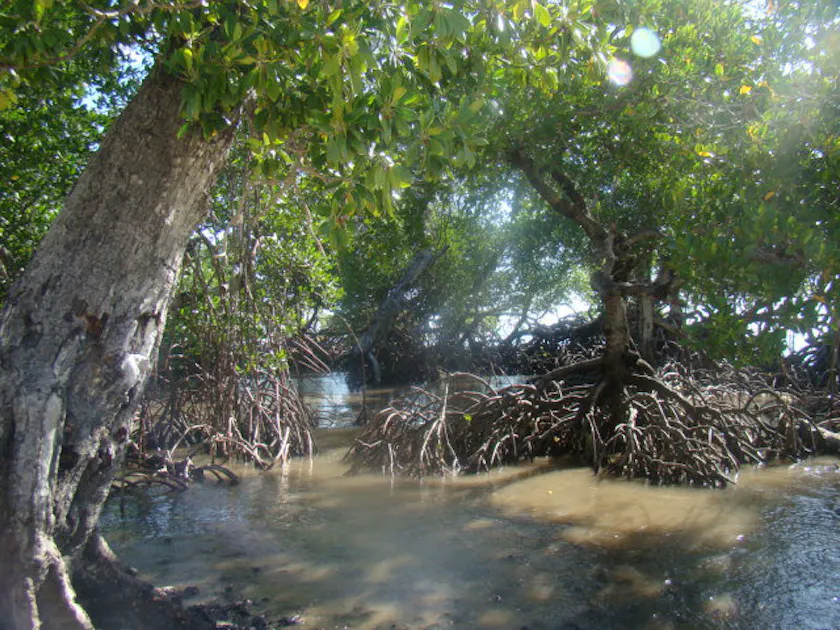
Restoring mangroves is an important strategy for increasing the resilience of small island nations to climate change. Established mangrove systems can protect people from flooding driven by storm surges (Worthington & Spalding, 2018). Mangroves also ensure food security for small islands as they are habitat to coastal fish and shellfish (Worthington & Spalding, 2018).
Mangroves are an existing ecosystem that has been degraded in Papua New Guinea. The project Mangrove Rehabilitation for Sustainably Managed Healthy Forests (MARSH) commenced on October 1st, 2012, and ended on September 30th, 2015. Building on Indigenous knowledge, workshops led local citizens and other partnerships to restore what had been lost. The project’s aim was to restore degraded mangrove areas to create more resilient communities and provide tangible co-benefits to communities. The outcome of the restoration projects sought to address increased water temperature and acidity stressing coral reefs, causing bleaching, and sea-level rise, which is eroding coastal environments (IUCN, 2016).
The project was implemented at 23 sites in five provinces in Papua New Guinea: National Capital District, Central, Manus, West New Britain, and New Ireland (IUCN, 2016). To implement the project across the five provinces, IUCN partnered with a number of national and international NGOs. These were The Nature Conservancy (TNC); Wildlife Conservation Society (WCS); PNG Centre for Locally Managed Marine Areas (PNGCLMA); Partners with Melanesians (PWM), PNG Assembly of Disabled Persons (PNGADP); and University of PNG (UPNG).
A mangrove use survey revealed a very high dependence on mangrove ecosystems for food, firewood, and construction materials (IUCN, 2016). Creating a more biodiverse mangrove area will have significant ecosystem benefits, including increased wildlife both below and above the water. Mangrove ecosystems play a critical role in supporting coastal fish and shellfish as they are a nursery habitat for wildlife before they migrate elsewhere.
The project replanted mangroves and also worked with local communities to educate people through 66 informal and formal training courses (IUCN, 2016). Restoration efforts saw 13,186 mangrove seedlings planted through 40 villages (IUCN, 2016). Planting activities were undertaken in partnership with several of the project partners such as the National Fisheries Authority (NFA), which generously supplied seedlings to demonstration sites in the National Capital District.
The open partnership nature of the project created more opportunities for locals to get involved. Active involvement by traditional leaders and community groups like the Pari Women’s Development Association contributed to the enthusiastic support by the communities. Multiple locals created mangrove nurseries in their backyards and went on to plant the mangroves (IUCN, 2016). An individual in West New Britain was so inspired by the MARSH activities in 2014 that he went on to plant 5,000 seedlings of his own initiative in 2015 (IUCN, 2016). The PNG Forest Authority (PNGFA) worked closely with the MARSH PMU in the carbon monitoring, reporting, and verification component of the project.
The economic value of mangrove fishery products was estimated at PGK600,000 per annum for Kimbe urban market alone, further highlighting the economic and food security provided by mangroves.
This project expanded on the outputs and results of the Mangrove Ecosystems for Climate Change Adaptation and Livelihoods (MESCAL) project that was implemented by IUCN in five other regional countries, including Solomon Islands and Vanuatu (IUCN, 2016). The scope and timeline of the project changed after three years. IUCN (2016) provides details and lessons learned.
References
- Bai, J., Meng, Y., Gou, R., Lyu, J., Dai, Z., Diao, X., … & Lin, G. (2021). Mangrove diversity enhances plant biomass production and carbon storage in Hainan island, China. Functional Ecology, 35(3), 774-786.
- IUCN Regional Office for Oceania, (2016). Mangrove Rehabilitation for Sustainably-Managed Healthy Forests Final Report. Prepared for Cooperative Agreement to a Public International Organization No. AID-492-A-12-00010, USAID, Philippines. https://png-data.sprep.org/dataset/mangrove-rehabilitation-sustainably-managed-healthy-forests-marsh-final-report
- Worthington, T., & Spalding, M. (2018). Mangrove restoration potential: A global map highlighting a critical opportunity.
Further resources: